Thursday, February 22, 2024

 Week of February 19 - 25 Come, Follow M3

1 Nephi  6-- 10


The words of Jacob, the brother of Nephi, which he spoke unto the people of Nephi:

Behold, my beloved brethren, I, Jacob, having been called of God, and ordained after the manner of his holy order, and having been consecrated by my brother Nephi, unto whom ye look as a king [leader] or a protector, and on whom ye depend for safety, behold ye know that I have spoken unto you exceedingly many things.  Nevertheless, I speak unto you again; for I am desirous for the welfare of your souls.  (2 Nephi 6: 1-3)


The Welfare of Your Souls

It had been forty years since Lehi and his family had left Jerusalem.[1] This would mean that Jacob must have been over thirty years old. Nephi had called him and his younger brother, Joseph, and ordained them to assist the work of the ministry.  Jacob had been consecrated by his brother who understood that leadership could only occur under principles of righteousness, and that people would accept a leader’s guidance when they knew they were loved.  Hence, Jacob’s concern for the welfare of the people’s souls. He loved them.  He was desirous that none of them should be lost to sin.


Jacob also loved Isaiah and studied his words from the Brass Plates.  In these verses, Jacob touched on the writings of Isaiah as he taught about the gathering of Israel in the last days; the role the Gentiles would play in the gathering; the coming of the Messiah in the meridian of time; the promise that He would come again at the last day. Though the world would be evil in that day with great tribulation, Jacob invites us to wait for Him. He will surely come. In that day, all flesh shall know that I the Lord am thy Savior and thy Redeemer, the Mighty One of Jacob. (v. 18)


[1]  See 2 Nephi 5: 34


Jacob was one of Nephi's younger brothers.  Two sons were born to Lehi and Sariah in the wilderness.  Lehi named them after their ancestors, the mighty patriarch, Jacob (Israel) and Joseph (of the Coat of Many Colors Fame.)  They were of particular interest to Jacob, not only because he bore the name, but also because he was a descendent of Jacob through Joseph who was sold into Egypt.


Day 2


Yea, for thus saith the Lord: Have I put thee away, or have I cast thee off forever? For thus saith the Lord: Where is the bill of your mother’s divorcement? To whom have I put thee away, or to which of my creditors have I sold you? Yea, to whom have I sold you? Behold, for your iniquities have ye sold yourselves, and for your transgressions is your mother put away.[1] (2 Nephi 7: 1)


You Have Sold Yourselves

Jacob taught the people some of the history of Israel.  Most of the Nephites, by then, had never known Jerusalem or the manner of prophesying among the Jews (2 Nephi 25: 1) so Nephi and Jacob had to teach them their own history. Jacob taught them, among other things, about the times when the God of Israel had stepped away from the people because they had stepped away from Him.  When that happened, the people tended to complain that God had forsaken them, as if it were His fault and none of their own.  They failed to understand that no parent can reward a child for deliberate disobedience and during much of the history, Israel had been openly disobedient. Many of the family of Lehi had likewise been rebellious and disobedient, primary the offspring of Laman and Lemuel, and as a result, they, too, had been cut off from God.  The Nephites themselves faced that potentiality if they ever were to turn from God.


Isaiah frequently used the metaphor of the Lord being the husband and Israel, the unfaithful wife.  He used that image in describing Israel’s estrangement from God by pointing out that He had not divorced them, though He had withdrawn for a time.  In ancient Israel, it was all too common that people sold their wives and children into slavery to pay their debts.  Apparently, ancient Israel accused the Lord of having done that.  Isaiah taught that Israel had sold herself by sin.


Do we ever sometimes try to blame God for our mistakes?  God will never force anyone.  We do what we choose to do because of our agency.  If we fail, it is our failure, not God’s.


[1] See Isaiah 50: 1

Wednesday, February 21, 2024

 the Book of mormon another testament of jesus christ  

A personal daily devotional diary: 1 Nephi


Which is to show unto the remnant of the house of Israel what great things the Lord hath done for their fathers; and that they may know the covenants of the Lord, that they are not cast off forever—And also to the convincing of the Jew and Gentile that Jesus is the Christ, the Eternal God, manifesting himself unto all nations (Title Page of the Book of Mormon)

Week 1: New Beginnings

As I begin each new year or new season, I often seek new projects. This is my project this year: to prepare a daily devotional study of The Book of Mormon, with commentary as the Spirit directs, and with space for the reader to add those things which the Spirit teaches him or her. Scripture quotes are downloaded from the website of The Church of Jesus Christ of Latter-Day Saints and are presented in italic format. My personal commentary is in plain text format.  The lines provide a place for the reader to write.  Today’s scripture is taken from the Title Page of The Book of Mormon. It cites at least two divine purposes of The Book of Mormon:

1.     To remind the Children of Israel of their Covenants with the Lord

2.     To testify unto the convincing of Jew and Gentile that Jesus is the Christ, Eternally God.

God is a covenant-making God. From the Covenants He made with Adam, Eve, Enoch, Noah, and Abraham, through the covenants He made with the Children of Israel and even beyond; those covenants are still in place and still available to all those who seek to be His people and to take upon them His name, Jesus Christ, to be their God.

What do the Covenants of the Lord mean in your life?


Should have started this a month ago. Bear with me. 

Tuesday, February 13, 2024


In Andrew Lloyd-Webber's musical, Joseph and His Amazing Technicolor Dreamcoat, one of the first songs introduces Israel this way: Jacob was the father of a whole new nation; because of the number of children he had; he was also known as Israel, but most of the time; his sons and wives only called him Dad!

Monday, February 12, 2024

BETHEL - House of Elohim


When Jacob first journeyed to his uncle's home, he had a vision of a ladder to heaven.  He erected a stone on the site and christened it with wine and oil.  He called the site Beth-El, meaning House (Beth) of God (Elohim).  Now, he has returned home to his original home and reconciled with his brother, Esau.  Then he received a commandment from the Lord, instructing him to go to Bethel and introduce his family at God's house.

To Latter-day Saints, Jacob's preparing his family to visit God's house can be compared to the preparations members must make to enter the Holy Temples of God's House.


One thing the Lord requested that Jacob do was to get rid of any pagan god images or even jewelry of such images among any who lived in his camp.  Some of his wives and servants had taken the household gods of Laban. This must have seemed like a huge sacrifice to Jacob's family, although God was adamant and, therefore, Jacob was adamant in His behalf.  The pagan items were buried deep beneath a large tree. (See Genesis 35)


Jacob had them wash themselves and their clothing to be as purified as possible to enter God's house.  Moses would later instruct the Children of Israel to do the same thing prior to meeting God (See Exodus)


God appeared to Jacob again. . . and blessed him. He said unto him, Thy name is Jacob (Usurper); thy name shall not be called any more Jacob but Israel shall be thy name.  (Genesis 35: 9-10)


Just as God changed Abram's name to Abraham, so, too, did he change Israel's name to a name that reflected his position as one who allows God to prevail in his life. The God renewed the Covenant with Israel:

  • Be fruitful and multiply; kings shall come from thy lineage.
  • Promise of Land given to Abraham passes to Israel
  • Reiterated the laws of Obedience and Sacrifice;
And Jacob set up a pillar in the place where he talked to him, even a pilar of stone: and he poured a drink offering thereon and poured oil thereon.


Sunday, February 11, 2024

Jacob; Before and After


Isaac called Jacob, and blessed him, and charged him, and said unto him, You shall not take a wife of the daughters of the Canaan. Arise and go to Padan-aram, to the house of Beheul, thy mother's father; and take a wife from the daughters of Laban, your mother's brother. (Genesis 28: 1-2)

Isacc then reiterated the blessing of Abraham for his son: God Almighty bless you and make you fruitful, and multiply you, that you may be a multitude of people; And give you the blessing of Abraham, to you and to your see with you; that you may inherit the land wherein you are a stranger, which God gave unto Abraham. (Genesis 28: 3-4)

One might suppose that Jacob was made perfect in the moment.  That was not the case.  He was blessed to know his potential, but it was up to him to make choices leading toward that potential. So can it be said of all of us.


When I was teaching the stories of Jacob in my Bible studies group, I became aware of the difference between young Jacob traveling to Pad-aram and the more mature and humbled Jacob, returning to his home with his wives and children. Let me go to the Bible to compare and contrast young Jacob and older Jacob:


Going to his uncle's land:

And he lighted upon a certain place, and tarried there all night, because the sun was set; and he took of the stones of that place and put them for his pillows, and lay down in that place to sleep.

And he dreamed, and behold a ladder set up on the earth, and the top of it reached to heaven: and the angels of God ascending and descending on it.

And, behold, the Lord stood above it, and said, I am the Lord God of Abraham they father, and the God of Isaac: the land whereon you lie, to thee will I give it, and to your seed   And your seed shall be as the dust of the earth . . . and in youu and your see shall all the families of the earth be blesssed. And I am with you and will keep you n all places wherever you go and will bring you again into this land.  (Genesis 28:11-15)


Jacob's first reaction was fear. Surely the Lord is in this place . . . how dreadful is this place, and this is the gate of heaven. (verses 16-17)


Before he left the place, he vowed to God the following:

  • If God will be with me,
  • And keep me in the way I go,
  • And will give me bread to eat,
  • And raiment to put on
  • So that I come again to my father's house in peace
Then shall the Lord be my God. (See Genesis 28: 20-21)

He set a stone for a pillar and called it God's house and promised to pay his tithes. (verses 21-22)  

While he did honor God in some ways, he gave God a list of things that God must do first and then he would be Isaac's God.

Fast forward fourteen years.  Jacob has had a tough life.  His uncle tries to cheat him, he is looked down upon in the community, until finally, it is no longer safe for him to stay. (See Chapters 29 and 30 of Genesis.)  

God commanded him (see Genesis 31: 13) to return home and he sneaked away at night with his wives and his children. (eleven sons and at least one daughter) 

Jacob was humbled.  He was leaving a father-in-law who wanted to kill him and heading toward a brother who at one time had wanted to kill him. 
 
That would get my attention!

Jacob prayed: O God of my father Abraham, and God of my father Isaac, the Lord which said to me "Return to your country and I will deal well with you.

I am not worth of the least of all the mercies, and of all the truth, which you have shown to thy servant for with my staff I passed over Jordon, and am now between two bands. Deliver me, I pray, from the hand of my brother, for the hand of Esau, for I fear him, lest he come and smite me and the mother of my children (Genesis 32: 9-11)

This is a very different Jacob. He placed no conditions on God but pleads, not for himself, but for his family and his children.

Esau's heart had also been softened and the brothers reconciled and reunited their large family. Having the birthright and the Covenant do not automatically deliver Jacob.  Jacob's own choices determine his fate.  How gracious, patient, and forgiving is the Lord toward Jacob.


Saturday, February 10, 2024

The Implication of the Covenant in the Lives of Isaac and Rebecca's Twins


Esau was a hunter;
 Jacob tended the home fires.

The birthright within the covenant was a complex thing.  Rebecca knew from the beginning that Jacob, the second born twin was to have the birthright.  Isaac, however, was not privy to that revelation apparently.  In fact, Isaac tended to favor Esau because Esau brought him fresh meat to eat.  Jacob stayed close to home and to his mother. 

However, Jacob kept to the covenant path, whereas Esau violated the covenant on a regular basis.  He didn't worship the God of Abraham and Isaac; Jacob did and offered sacrifices.  Esau married a local Hittite girl, who was outside the covenant, much to the dismay of his parents.  Jacob remained single because there were no local girls who were covenant maidens.

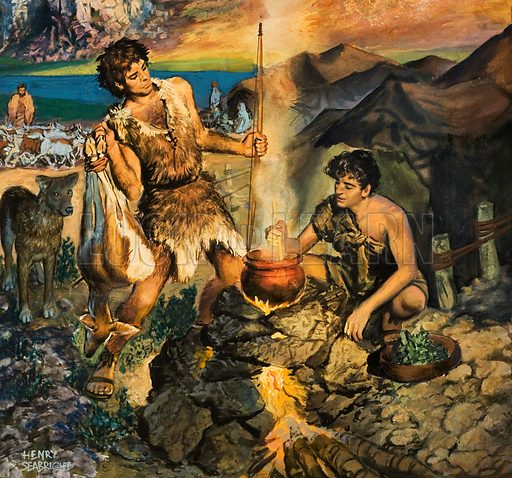
The story is told that one day when Esau returned from the hunt, he found his brother cooking a mess of pottage, a stew made of lentils and grains.  Esau was hungry and asked Jacob for some stew.  According to the Bible, Jacob was selling the pottage and asked Esau to pay for it with his birthright.  Esau reasoned that if he died from hunger, the birthright would be no use to him.  

Then Jacob gave Esau bread and pottage of lentils; and he did eat and drink, and rose up and went on his way: thus Esau despised his birthright. (Genesis 25: 34) 

Isaac grew old and was blind. He called for Esau to take his bow and go hunting, then prepare the meat in a savory dish that he loved.  He promised he would then bless Esau before he died.

Rebecca overheard and was not happy about it.   She knew from conception that Jacob was to be the blessed one.  She also knew the Jacob was faithful and obedient to God.  Since the birthright son was given the responsibility to care for the spiritual as well as physical needs his mother and the family, Rebecca knew that Esau was not faithful and obedient.  While he probably could have cared for his family's physical needs, he was in no way qualified to care for their spiritual needs.

Given all these facts, Rebecca called Jacob to her and came up with a plot to trick Isaac into giving the birthright blessing to Jacob. The story of their trickery is found in chapter 27 of Genesis. I do not want to argue the rightness, or the wrongness of what Rebecca chose to do, although, as a mother, I understand her reasons for doing it.  Suffice it to say, the blessing went to Jacob. He blessed him with prosperity, posterity, and leadership of the family (See verse 28)


Esau was furious and sought his brother's life. Jacob was forced to flee for safety. Rebecca directed him to go to her brother's home to find a wife within the covenant.


Friday, February 9, 2024

The Lord Affirms the Covenant with Isaac


Laban asked his sister if she would go with Abraham's servant to become the wife of Isaac.  She said yes. Then Laban blessed Rebecca: 
Thou art our sister, be thou the mother of thousands of millions. (Genesis 24:60) 

Isaac loved Rebekkah and she him, but unfortunately the blessing of motherhood didn't occur.  Like her mother-in-law, Sarah, Rebekkah was barren.  In the midst of all this, there was a famine in the land. Isaac went to a neighboring king and asked permission to stay in Gerar, a land just north of Beersheba, in what was then Philistia.  

While they were there, Isaac was visited by the Lord, who re-affirmed the Covenant with Isaac. 

The Lord appeared unto him, and said, Go not down into Egypt; dwell in the land which I shall tell thee of: Sojourn in this land, and I will be with thee, and will bless thee; for unto thee and unto thy seed, I will give all the countries, and I will perform the oath which I swore unto Abraham thy father; And I will make thy seed to multiply as the stars of heaven, and will give into thy seed all these countries; and in thy seed shall all the nations of the earth be blessed; Because that Abraham obeyed my voice and kept my charge, my commandments, my statutes, and my laws. (Genesis 26: 2-5)

Isaac and the herdsmen of Gerar got into a feud over water.  Isaac went into Beersheba to keep the peace. 

And the Lord appeared unto him the same night, and said, I am the God of Abraham thy father: fear not, for I am with thee, and will bless thee, and multiply thy seed for my servant Abraham's sake. And [Isaac] bult an altar there, and called upon the name of the Lord, and pitched his ten there: and there Isaac's servants dug a well. (Genesis 26: 23-25)

After Abraham died and was buried by Isaac and Ishmael, Isaac began in earnest to pray for his wife that she might conceive. In Genesis 25, we read:  

And Isaac entreated the Lord for his wife, because she was barren. And the Lord entreated of him, and Rebekah his wife conceived.
 
And the children struggled together within her; and she said, If it be so, why am I thus? And she went to inquire of the Lord. And the Lord said unto her, Two nations are in thy womb, and two manner of people shall be separated from thy bowels; and the one people shall be stronger than the other people; and the elder shall serve the younger.  And when her days to be delivers were fulfilled, behold there were twins in her womb. (Genesis 25: 21-24)


The first born was a baby boy they named Esau because he was hairy and Esau means Hairy.  The second child was also a boy.  As Esau emerged from the womb, the second baby grabbed his heel.  They named him Jacob which means, among other things, Usurper