Sunday, February 11, 2024

Jacob; Before and After


Isaac called Jacob, and blessed him, and charged him, and said unto him, You shall not take a wife of the daughters of the Canaan. Arise and go to Padan-aram, to the house of Beheul, thy mother's father; and take a wife from the daughters of Laban, your mother's brother. (Genesis 28: 1-2)

Isacc then reiterated the blessing of Abraham for his son: God Almighty bless you and make you fruitful, and multiply you, that you may be a multitude of people; And give you the blessing of Abraham, to you and to your see with you; that you may inherit the land wherein you are a stranger, which God gave unto Abraham. (Genesis 28: 3-4)

One might suppose that Jacob was made perfect in the moment.  That was not the case.  He was blessed to know his potential, but it was up to him to make choices leading toward that potential. So can it be said of all of us.


When I was teaching the stories of Jacob in my Bible studies group, I became aware of the difference between young Jacob traveling to Pad-aram and the more mature and humbled Jacob, returning to his home with his wives and children. Let me go to the Bible to compare and contrast young Jacob and older Jacob:


Going to his uncle's land:

And he lighted upon a certain place, and tarried there all night, because the sun was set; and he took of the stones of that place and put them for his pillows, and lay down in that place to sleep.

And he dreamed, and behold a ladder set up on the earth, and the top of it reached to heaven: and the angels of God ascending and descending on it.

And, behold, the Lord stood above it, and said, I am the Lord God of Abraham they father, and the God of Isaac: the land whereon you lie, to thee will I give it, and to your seed   And your seed shall be as the dust of the earth . . . and in youu and your see shall all the families of the earth be blesssed. And I am with you and will keep you n all places wherever you go and will bring you again into this land.  (Genesis 28:11-15)


Jacob's first reaction was fear. Surely the Lord is in this place . . . how dreadful is this place, and this is the gate of heaven. (verses 16-17)


Before he left the place, he vowed to God the following:

  • If God will be with me,
  • And keep me in the way I go,
  • And will give me bread to eat,
  • And raiment to put on
  • So that I come again to my father's house in peace
Then shall the Lord be my God. (See Genesis 28: 20-21)

He set a stone for a pillar and called it God's house and promised to pay his tithes. (verses 21-22)  

While he did honor God in some ways, he gave God a list of things that God must do first and then he would be Isaac's God.

Fast forward fourteen years.  Jacob has had a tough life.  His uncle tries to cheat him, he is looked down upon in the community, until finally, it is no longer safe for him to stay. (See Chapters 29 and 30 of Genesis.)  

God commanded him (see Genesis 31: 13) to return home and he sneaked away at night with his wives and his children. (eleven sons and at least one daughter) 

Jacob was humbled.  He was leaving a father-in-law who wanted to kill him and heading toward a brother who at one time had wanted to kill him. 
 
That would get my attention!

Jacob prayed: O God of my father Abraham, and God of my father Isaac, the Lord which said to me "Return to your country and I will deal well with you.

I am not worth of the least of all the mercies, and of all the truth, which you have shown to thy servant for with my staff I passed over Jordon, and am now between two bands. Deliver me, I pray, from the hand of my brother, for the hand of Esau, for I fear him, lest he come and smite me and the mother of my children (Genesis 32: 9-11)

This is a very different Jacob. He placed no conditions on God but pleads, not for himself, but for his family and his children.

Esau's heart had also been softened and the brothers reconciled and reunited their large family. Having the birthright and the Covenant do not automatically deliver Jacob.  Jacob's own choices determine his fate.  How gracious, patient, and forgiving is the Lord toward Jacob.


Saturday, February 10, 2024

The Implication of the Covenant in the Lives of Isaac and Rebecca's Twins


Esau was a hunter;
 Jacob tended the home fires.

The birthright within the covenant was a complex thing.  Rebecca knew from the beginning that Jacob, the second born twin was to have the birthright.  Isaac, however, was not privy to that revelation apparently.  In fact, Isaac tended to favor Esau because Esau brought him fresh meat to eat.  Jacob stayed close to home and to his mother. 

However, Jacob kept to the covenant path, whereas Esau violated the covenant on a regular basis.  He didn't worship the God of Abraham and Isaac; Jacob did and offered sacrifices.  Esau married a local Hittite girl, who was outside the covenant, much to the dismay of his parents.  Jacob remained single because there were no local girls who were covenant maidens.

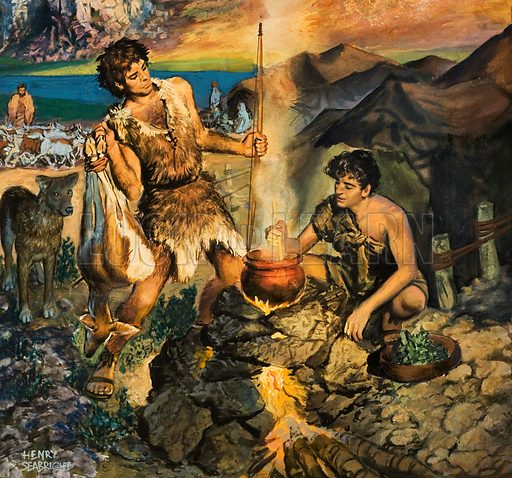
The story is told that one day when Esau returned from the hunt, he found his brother cooking a mess of pottage, a stew made of lentils and grains.  Esau was hungry and asked Jacob for some stew.  According to the Bible, Jacob was selling the pottage and asked Esau to pay for it with his birthright.  Esau reasoned that if he died from hunger, the birthright would be no use to him.  

Then Jacob gave Esau bread and pottage of lentils; and he did eat and drink, and rose up and went on his way: thus Esau despised his birthright. (Genesis 25: 34) 

Isaac grew old and was blind. He called for Esau to take his bow and go hunting, then prepare the meat in a savory dish that he loved.  He promised he would then bless Esau before he died.

Rebecca overheard and was not happy about it.   She knew from conception that Jacob was to be the blessed one.  She also knew the Jacob was faithful and obedient to God.  Since the birthright son was given the responsibility to care for the spiritual as well as physical needs his mother and the family, Rebecca knew that Esau was not faithful and obedient.  While he probably could have cared for his family's physical needs, he was in no way qualified to care for their spiritual needs.

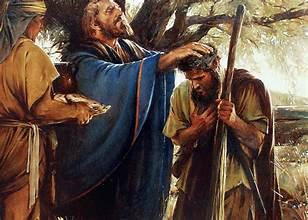
Given all these facts, Rebecca called Jacob to her and came up with a plot to trick Isaac into giving the birthright blessing to Jacob. The story of their trickery is found in chapter 27 of Genesis. I do not want to argue the rightness, or the wrongness of what Rebecca chose to do, although, as a mother, I understand her reasons for doing it.  Suffice it to say, the blessing went to Jacob. He blessed him with prosperity, posterity, and leadership of the family (See verse 28)


Esau was furious and sought his brother's life. Jacob was forced to flee for safety. Rebecca directed him to go to her brother's home to find a wife within the covenant.


Friday, February 9, 2024

The Lord Affirms the Covenant with Isaac


Laban asked his sister if she would go with Abraham's servant to become the wife of Isaac.  She said yes. Then Laban blessed Rebecca: 
Thou art our sister, be thou the mother of thousands of millions. (Genesis 24:60) 

Isaac loved Rebekkah and she him, but unfortunately the blessing of motherhood didn't occur.  Like her mother-in-law, Sarah, Rebekkah was barren.  In the midst of all this, there was a famine in the land. Isaac went to a neighboring king and asked permission to stay in Gerar, a land just north of Beersheba, in what was then Philistia.  

While they were there, Isaac was visited by the Lord, who re-affirmed the Covenant with Isaac. 

The Lord appeared unto him, and said, Go not down into Egypt; dwell in the land which I shall tell thee of: Sojourn in this land, and I will be with thee, and will bless thee; for unto thee and unto thy seed, I will give all the countries, and I will perform the oath which I swore unto Abraham thy father; And I will make thy seed to multiply as the stars of heaven, and will give into thy seed all these countries; and in thy seed shall all the nations of the earth be blessed; Because that Abraham obeyed my voice and kept my charge, my commandments, my statutes, and my laws. (Genesis 26: 2-5)

Isaac and the herdsmen of Gerar got into a feud over water.  Isaac went into Beersheba to keep the peace. 

And the Lord appeared unto him the same night, and said, I am the God of Abraham thy father: fear not, for I am with thee, and will bless thee, and multiply thy seed for my servant Abraham's sake. And [Isaac] bult an altar there, and called upon the name of the Lord, and pitched his ten there: and there Isaac's servants dug a well. (Genesis 26: 23-25)

After Abraham died and was buried by Isaac and Ishmael, Isaac began in earnest to pray for his wife that she might conceive. In Genesis 25, we read:  

And Isaac entreated the Lord for his wife, because she was barren. And the Lord entreated of him, and Rebekah his wife conceived.
 
And the children struggled together within her; and she said, If it be so, why am I thus? And she went to inquire of the Lord. And the Lord said unto her, Two nations are in thy womb, and two manner of people shall be separated from thy bowels; and the one people shall be stronger than the other people; and the elder shall serve the younger.  And when her days to be delivers were fulfilled, behold there were twins in her womb. (Genesis 25: 21-24)


The first born was a baby boy they named Esau because he was hairy and Esau means Hairy.  The second child was also a boy.  As Esau emerged from the womb, the second baby grabbed his heel.  They named him Jacob which means, among other things, Usurper


Thursday, February 8, 2024

Isaac and the Covenant

When Isaac as old enough to take a wife, his father, Abraham, was concerned greatly that he not marry outside of the Covenant line.  Since Abraham lived in the midst of the Canaanites, there were none of the line for Isaac to marry.  Therefore, he called his eldest servant and gave him a commission:  

And I will make thee swear by the Lord, the God of heaven, and the God of the earth, that thou shalt not take a wife unto my son of the daughters of the Canaanites, among whom I dwell: But thou shalt go into my country, and to my kindred, and take a wife unto my son Isaac. (Genesis 24: 3-4)

Abraham's servant set out for the City
of Nahor to find a suitable wife for Isaac.

Abraham's servant journeyed to the home of Abraham's nephew, Laban. Laban's father, Bethuel, was the son of Abraham's elder brother, Nahor. both Nahor and Bethuel had died, and Laban was, under his birthright, taking care of his extended family. This included his younger sister, Rebekah.

The servant was concerned that he chose the right wife for Isaac, and he had prayed fervently on his journey that God would reveal the chosen one to him. When he arrived at Nahor, he had his ten camels kneel outside the city by the well where the women came to draw water every evening.  He prayed: 

O Lord God of my master Abraham, I pray thee send me good speed this day and show kindness unto my master Abraham.  Behold, I stand here by the well of water; and the daughters of the men of the city come out to draw water: And let it come to pass, that the damsel to whom I shall say, Let down thy pitcher, I pray thee, that I may drink; and she shall say, Drink and I will give thy camels drink also: let the same be she that thou have appointed for thy servant Isaac; and thereby shall I know that thou have shown kindness unto my master. (Genesis 24: 12-14)


Found this little gem online: a camel coming from
the desert can drink about 25 gallons of water.
Drink, my lord: and she hasted, and let down her pitcher upon her hand, and gave him drink. And when she had done giving him drink, she said, I will draw water for thy camels also, until they have done drinking. And she hasted, and emptied her pitcher into the trough, and ran again unto the well to draw water, and drew for all his camels. (Genesis 24: 18-20)


A water pitcher from this part of Bronze Age Palestine holds between two and three gallons, but let’s call it 2.5 gallons just to make this easy. That comes to about 100 trips to the well, drawing over a ton of water. She did this for a complete stranger and did so without being asked. *

*Rebecca at the Well or, Going the Extra Mile for the Camels - Rational Faiths | Mormon Blog


Having faith that the Lord had shown his will, the servant negotiated with Laban for Rebecca to marry Isaac. Such was the power of the covenant.

Tuesday, February 6, 2024

Thy Son; Thy Only Son - Birthright


Perhaps the best-known story about the Patriarch Abraham was that of his sacrifice of his son, Isaac. This is an important event on several levels. One of these relates to the Covenant: Issac, as Abraham and Sariah's only born child, held the birthright of the Covenant.

On the Church website, I found these facts about the birthright:

Under the patriarchal order, the right or inheritance of the firstborn is known as birthright. This generally included a land inheritance as well as the authority to preside. The firstborn of flocks and of human families was considered as belonging to the Lord and was expected to be dedicated to Him. 

There are several instances in the scriptures of the one who was the firstborn losing his birthright because of unrighteousness and his office being given to another; such was the case with Esau. * 

This was also the case with Jacob's firstborn child, Reuben, a son born of Jacob's wife, Leah.  When Reuben violated his father's bed, he lost the birthright.  It is interesting that the birthright did not pass to Jacob's second born son of Leah, Simeon, but of his firstborn son of his beloved wife, Rachel. 

In the case of Abraham, Ishmael was his firstborn son of his concubinical wife, Hagar. (This may be why the Muslim's believe that it was Ishamael whom God commanded Abraham to sacrifice.)  However, under the complex laws of marriage and inheritance among the Israelites, as a concubine or secondary wife, Hagar's children were not entitled to receive Abraham's birthright, which had to do, at least in part, with the priesthood.  Sarah was Abraham's primary wife, and it was her child, Isaac, who was to inherit the birthright.  So, when the scriptures tell us that God said: Take now they son, thine only son, Isaac, (Genesis 22:2) they were right on point.

Abraham became the father of many nations through his multiple wives, but it was only Sarah's child, Isaac, through whom the birthright passed. 


Monday, February 5, 2024

Abraham - Patriarch of the Covenant


Abraham lived around 2,000 B. C. E. He was descended from Noah through his son, Shem (from which source we get the term Semite.) The Bible talks a lot about Abraham in both the Old and New Testaments, but latter-day scripture expands even on that.  For example, we read in the Book of Abraham (as translated from Egyptian papyri) that one of the motivating factors for which Abraham journeyed from his home in Mesopotamia, ultimately ending up in the Land of Cainan, was to become an active participant in the God's Covenant with man.  He wrote:

I sought for the blessings of the fathers, and the right whereunto I should be ordained to administer the same; having been myself a follower of righteousness . . . (Abraham 1: 2)  

Who were the fathers to whom he referred? He tells us:

. . . it came down from the fathers, from the beginning of time, yea, even from the beginning or before the foundation of the earth, even the right of the firstborn, or the first man, who is Adam, or first father, through the fathers unto me. . .  I sought for mine appointment unto the Priesthood according to the appointment of God unto the father concerning seed. (Abraham 1: 3-4)

Abraham wanted the blessings of the Covenant, founded in Heaven and continued on the earth from Adam, through Seth, Enoch, and Shem and all the righteous followers of God from the beginning. This Covenant had three key promises:

Posterity - Children more numerous than the stars in the Heavens. He would become the father of many nations.


Prosperity - Promises of land and sufficient means to supply needs.

Priesthood - I will be your God and you will be my people. Through my priesthood, I will give you the power to act and bless in my name and administer the ordinances of my Gospel.


In the Doctrine and Covenants we learn that Abraham was ordained to the Priesthood by Melchizedek who had received it through Noah. (See Doctrine and Covenants 84: 14)

Speaking of Melchizedek and this interchange with Abraham, the Lord told the Prophet Joseph Smith:

I am the Lord thy God and will give unto you the law of my Holy Priesthood, as was ordained by me and my Father before the world was . . . For this Melchizedek, king of Salem, priest of the most high God, who met Abraham . . . to whom also Abraham gave a tenth part of all; first being interpreted King of righteousness, and after that also King of Salem, King of Peace.  (Doctrine and Covenants 138: 27, 29-30) 

Paul wrote to the Hebrews and drew this contrast between the Priesthood of Melchizedek and the Priesthood of Aaron, noting that Abraham predated Moses. Paul also taught that Jesus Christ was a high priest after the order of Melchizedek. (See Hebrews 5: 10) The Jews were clinging to the Law of Moses and the Levitical priesthood and Paul wanted them to understand that Jesus was greater than the Law. 

Three great religions trace their lineage through Abraham: Judaism, Christianity, and Islam.  Christians and Jews speak of the God of Abraham, Isaac, and Jacob. This chart ignores a major Christian religion: the restored Church of Jesus Christ of Latter-day Saints. Many people group them with Protestants, but they are not protesting anything.  They are the restoration of First Century Christianity as taught by Jesus.  In fact, Jesus is the also the Prince of Peace and the King of Righteousness, both a king and a priest. Melchizedek is a type of Jesus Christ in that regard.


Friday, February 2, 2024

The Dispensation of Noah and of God's Covenant with Him

Like his great-grandfather, Enoch, Noah was a righteous man who loved and obeyed God. In fact, the Lord taught Moses that Noah was a perfect man in his generation. (Genesis 6:9) 

And the Lord ordained Noah after his own order and commanded him that he should go forth and declare his Gospel unto the children of men, even as it was given unto Enoch. And it came to pass that Noah called upon the children of men that they should repent; but they hearkened not unto his words. (Moses 8: 19, 20) 


Like prophets Jeremiah, Lehi, and Mormon, Noah was called to preach repentance to a group of people whose day of grace had passed.

Wickedness was so entrenched that God knew they were incapable of repentance. It is difficult to think of a more discouraging calling.

A later Old Testament prophet, Amos, wrote that God will do nothing save he reveals his secrets unto his servants the prophets. (Amos 3: 7) God had revealed the inevitability of destruction to Enoch; now He did so with to Noah. God saw that the wickedness of men had become great in the earth: and every man was lifted up in the imagination of the thoughts of his heart, being only evil continually. (Moses 8: 22

God instructed Noah to prepare his family to escape the judgment. He said: Make thee an ark of gopher wood. . . And this is the fashion which thou shalt make of it: (Since a picture is worth 1,000 words, so here it is, just as explained in Genesis 8: 15-17)


But with thee will I establish my covenant; and thou shalt come into the ark, thou, and thy sons, and thy wife, and thy sons’ wives with thee. (Genesis 6: 18)

God commanded Noah to collect two of every animal, male and female, and five of all clean animals (for meat and sacrifice) Thus did Noah did according to all that God commanded him. (Genesis 6: 22)

When everything was completed, God commanded Noah to enter the ark with his family, the animals, and all the supplies God had asked him to gather. (See Genesis 7) And every living substance was destroyed which was upon the face of the ground. . . and Noah only remained alive, and they that were with him in the ark. And the waters prevailed upon the earth 150 days. (Genesis 7: 23-24) 

However, Noah and his family and the animals aboard the ark did not perish.  God kept His promise.  

After the waters abated and the earth was dry, God spoke again: 

Go forth of the ark, thou, and thy wife, and thy sons, and thy sons' wives with thee.  Brint forth with thee every living thing that is with thee . . . be fruitful and multiply upon the earth. (Genesis 8: 16-17)

And God blessed Noah and his sons, and said unto them, Be fruitful and multiply and replenish the earth. (Genesis 9: 1)

And Noah built an altar unto the Lord; and took of every clean beast . . . and fowl and offered burnt offerings on the altar.  And the Lord smelled a sweet savor . . . (Genesis 8: 20)

As I read these verses, I am remembering the covenants God made with Adam and Eve in the Garden: Obedience and sacrifice: be fruitful and fill the earth with your posterity. And God made a further covenant with Noah and his seed and with every living creature upon the earth. To my knowledge, I believe this is the only covenant that God made with all living creatures:

And I, behold, I will establish my covenant with you, and with your seed after you; and with every living creature that is with you . . . all that go out of the ark. And I will establish my covenant with you; neither shall all flesh be cut off any more by the waters of a flood. . . (Genesis 9: 9-11) 


And God said, this is the token of the covenant which I make between me and you and every living creature that is with you, for perpetual generations. (Genesis 9: 12)

Most covenants with God involve a two-way promise: I will be your God and do these things for you and you will be my children and do these things for me.  This is one of the few covenants that God made that is unconditional. The Rainbow itself is not the covenant: it is a token of the covenant; given to us as a sign of God's promise to the world.

It hurts my heart that this token has been usurped by those who would deny God and seek to justify the pride in their own hearts.